Plywood vs MDF vs Particle Board: Which Is Best for Furniture?
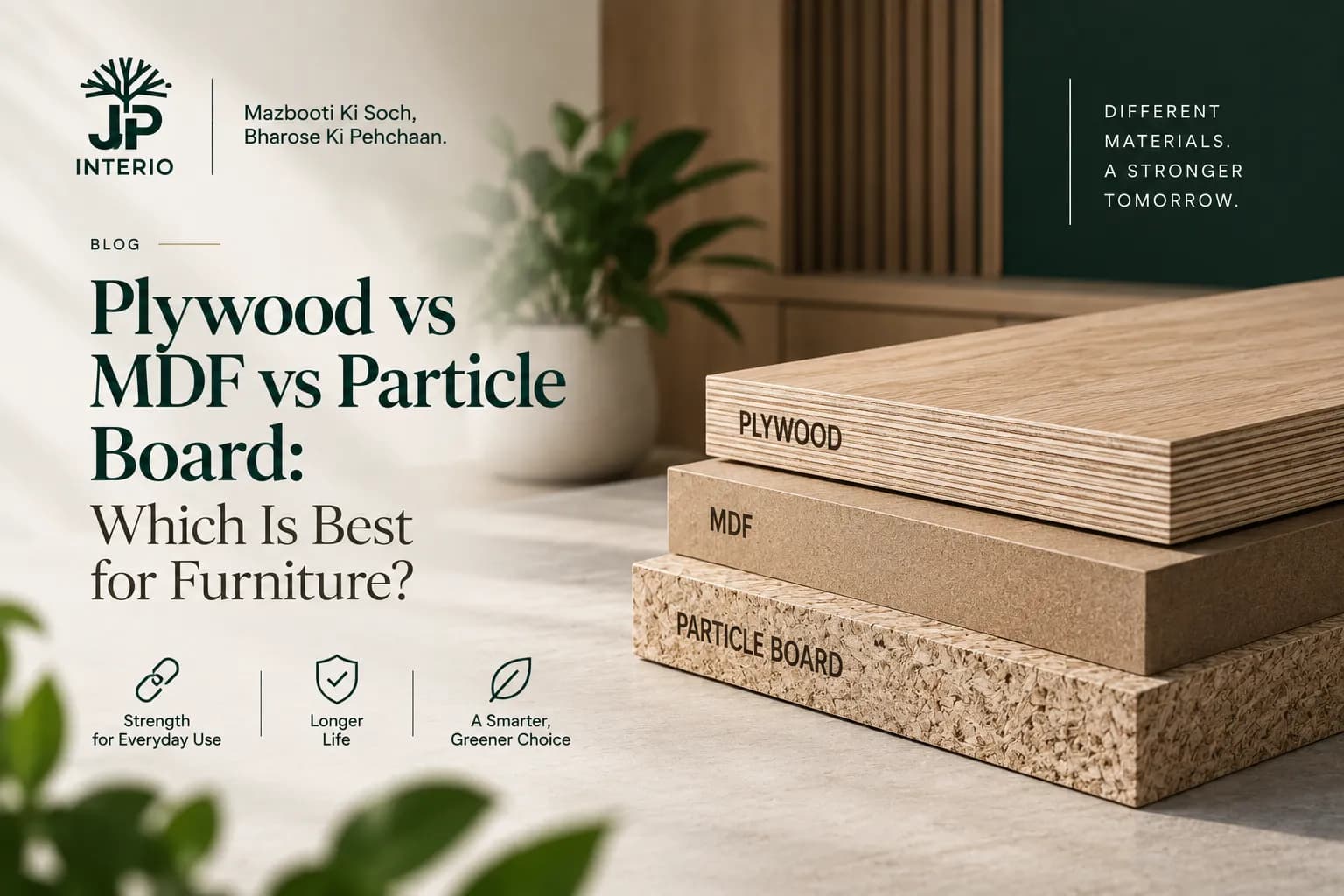
Planning new furniture can quickly become confusing. Your carpenter recommends plywood. Your interior designer mentions MDF. A modular furniture company offers particle board. So, which one is actually better?
The answer depends on what you are building. Plywood, MDF and particle board are all engineered wood products, but they have different characteristics and applications.
What Is Plywood?
Plywood is manufactured by bonding layers of wood veneer together. Its layered construction gives it useful structural characteristics and makes it widely used for furniture and interior applications.
One major advantage of plywood is that different grades can be selected according to moisture exposure.
JP Interio's BondSeal 710 range includes:
- MR
- BWR
- BWP
This allows the plywood grade to be selected according to the environment.
What Is MDF?
MDF stands for Medium Density Fibreboard. It is manufactured from refined wood fibres compressed into panels.
MDF provides a smooth, uniform surface and can be useful for:
- Painted furniture
- Decorative panels
- Wall applications
- Certain cabinet components
Its suitability depends on the environment and the specific MDF product being used.
What Is Particle Board?
Particle board is made from wood particles bonded together.
It is often used in cost-conscious furniture and modular systems. It can work well in suitable applications, but the environment, load and product specification should always be considered.
Plywood vs MDF vs Particle Board
| Factor | Plywood | MDF | Particle Board |
|---|---|---|---|
| Structural use | Strong option | Moderate | Application-dependent |
| Moisture options | MR/BWR/BWP | Product dependent | Product dependent |
| Surface | Good | Very smooth | Smooth |
| Furniture use | Extensive | Extensive | Extensive |
| Kitchen suitability | Grade dependent | Varies | Product dependent |
| Cost | Product dependent | Often economical | Often economical |
Which Is Best for Kitchen Furniture?
For structural kitchen furniture, plywood is often considered when strength and moisture resistance are priorities.
The grade matters. For example, BondSeal 710 BWR has a 10-year warranty and can be considered for moisture-prone kitchen applications.
BondSeal 710 BWP carries a 15-year warranty and can be considered for higher-moisture applications.
Which Is Best for Wardrobes?
For a standard dry bedroom wardrobe, properly specified MR plywood can be a practical option.
BondSeal 710 MR carries a 5-year warranty.
MDF can also be suitable for selected wardrobe components where a smooth decorative finish is important.
The final choice should depend on the furniture design, environment and finish requirement.
Don't Compare Only the Price
A common mistake is to compare materials only by cost per square foot.
Instead, consider:
- Expected service life
- Moisture exposure
- Structural requirements
- Hardware
- Installation
- Surface finish
- Maintenance
- Replacement cost
The cheapest sheet is not necessarily the most economical material for the application.
Conclusion
Plywood, MDF and particle board all have their place in modern interiors. The right material depends on the job.
For structural and moisture-sensitive furniture, properly specified plywood can be an excellent choice.
For decorative and smooth-surface applications, MDF may be useful.
Particle board can work well in selected cost-conscious furniture applications.
The smartest decision is not to ask:
"Which material is always best?"
Ask:
"Which material is best for this particular application?"
FAQs
Is plywood stronger than MDF?
Plywood generally offers strong structural performance, but actual performance depends on quality, thickness and design.
Is MDF suitable for wardrobes?
Yes, MDF can be suitable for selected wardrobe applications, particularly where a smooth decorative surface is desired.
Is plywood better than particle board?
For applications requiring structural strength and moisture resistance, properly specified plywood may be preferable. However, suitability depends on the specific furniture application.